
Why e-portfolios and Metacognition? Who cares?

Ahead of, and with additional thanks to the pandemic, digital technology has been thrust into the education stratosphere like never before. Teachers are picking up tools to bring into their learning environments with well-meaning intentions, but what is happening here? Well-meaning intentions aside, are students getting the absolute benefits from these tools?

Existing models of metacognition outline the potential for external variables to input into the process. However, it did not encompass the entirety of the metacognitive process; motivation, context, knowledge, skills and experiences. By merging the COPES (Winne, 1979) model with the MASRL model (Efklides, 2011), there is a framework with which we can see the importance digital tools play in the important metacognitive process. The MAC-SRL model incorporates the important functionality of conditions, operations and products with the intersections of motivation and context. These intersections are interchangeable and serve as a pathway to understanding how digital tools and educators, as external stimuli, can affect the metacognitive growth of students. Motivation has an implied affect on all steps of the metacognitive process, from engagement through re-direction and reflection and reiteration, and its absence in frameworks is noted. Correlating increased motivation with digital tools has been made by a plethora of researchers (Schunk, 2012). As such, educators must begin to experience vital tools that can support both their learning and pedagogy while also improving academic achievement.

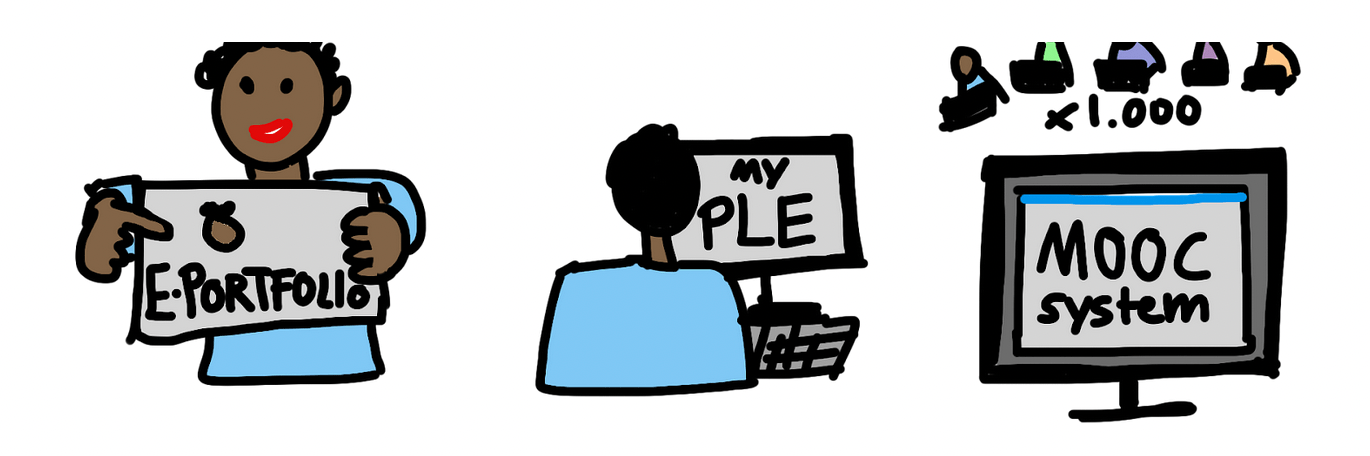
In Ontario, the public education system adopted a new early years curriculum, supported by D2L’s Brightspace portfolio to document learning. This portfolio highlights the rationale for understanding how best they can serve student learning. The e-portfolio gives student ownership, author rights and a bridge to build communication between home and school. The e-portfolio has substantial metacognitive learning opportunities and further develops cognitive functions within learning environments with variability to suit any need. With the future potential to incorporate Web 3.0 technologies, blockchain and chatbots, the implications of add-ons to the e-portfolio present many opportunities to interact with learners to support their metacognitive growth.

References

Efklides, A., (2011). Interactions of Metacognition With Motivation and Affect in Self-Regulated Learning: The MASRL Model. Educational Psychologist, 46(1), pp 6-25. https://doi.org/10.1080/00461520.2011.538645 

Schunk, D. H. (2012). Learning Theories: An Educational Perspective (6th ed.). Upper Saddle River, NJ: Pearson.


What about Self-Regulated Learning?

Self-regulated learning is often considered the umbrella that covers metacognition. When we think about self-regulation, often we may be distracted by the biased nature in which we assess it on report cards, or in the way that self-regualtion and dysregulation present. As it applies to metacognition, self-regulated learning (SRL) incorporates the many emotional and psychological aspects of neuro-processes, and how those interact with our thinking, and therefore metacognition. Dr. Stuart Shanker talks in length about the limbic system within our brains, and what he calls the red brain blue brain processes (Shanker, 2017). When the brain is over-loaded with stressors and cognitive processing, it enters into what Dr Shanker calls “red brain” which effectively leaves the learning portion of the brain offline. Neuroscience has come a long way over the past decade and the ability to identify these intricacies gives educators and parents alike better understanding of how to support young (and old) people. It also helps us navigate our digital tools in a way that provides constructive alternatives for co-regualtion, and other important re-regulating tools for young people who are just starting to learn about these functions. There is plenty of research that supports the need for self-regulation and how self-regulated learners have higher levels of academic success (Greene & Azevedo, 2007), which must imply the inclusion of metcognition as we know that those with higher academic outcomes also have strong metacognitive functions. 

Greene, J. A., & Azevedo, R. (2007). A Theoretical Review of Winne and Hadwin’s Model of Self-Regulated Learning: New Perspectives and Directions. Review of Educational Research, 77(3), 334–372. http://www.jstor.org/stable/4624902
Shanker, S. (2017). Self-Reg: How to Help Your Child (and You) Break the Stress Cycle and Successfully Engage with Life. Penguin Canada.

Have we developed metacognitively deficient learners by creating immediate access to answers (internet)? 

In the times when the internet and digital devices that handle internet access become ubiquitous, have impending implications on overall student learning? With a grain of salt, what the impact might be from a different lens than the usual mental health, inactivity or other arguments that have been made. Not to make light of those, as they are essential to the overall conversation, but instead, a different perspective.

While many review the internet as a means to quick answers and a never-ending source of learning, it may also impact learners’ ability to think about what they need to be successful and, importantly, become more dependent on external factors for their learning. While teachers are conscious of learners losing motivation post-COVID-19, perhaps we need to look at other factors. Perhaps it is the lack of thinking needed with the internet so close at hand. When needing an answer, one must click the search bar a few short words late, and very likely, there will be an answer. The consumer does not necessarily know if that answer is correct or in line with the context in which they were searching. However, the overarching quest for an answer is complete. Metacognition is two segments, internal and external, and the interaction between the many factors that intersect, resulting in behavioural consequences regarding academic performance (Hartman, 2001). Breaking this down, the internal factor here is the ability to ask a question. We are focused on the dependence, and therefore the lack of learning autonomy, that could come from having information ready. What happens when we face a challenging question that the internet cannot solve? Perhaps there is an overarching need, not that this needs to be repeated, to investigate the purpose of schools and the role of education in the 21st century and critique the skills necessary to succeed (Griffin, Care, & McGaw, 2012). Perhaps our learned automaticity of relying on the internet is detrimental to our overall academic achievements.

Griffin, P., Care, E., McGaw, B. (2012). The Changing Role of Education and Schools. In: Griffin, P., McGaw, B., Care, E. (eds) Assessment and Teaching of 21st Century Skills. Springer, Dordrecht. https://doi.org/10.1007/978-94-007-2324-5_1 

Hartman, H.J. (2001). Developing Students’ Metacognitive Knowledge and Skills. In: Hartman, H.J. (eds) Metacognition in Learning and Instruction. Neuropsychology and Cognition, vol 19. Springer, Dordrecht. https://doi.org/10.1007/978-94-017-2243-8_3 

What the heck is Metacognition?

Reading article after article about metacognition, and one is left wondering, what the heck is it anyways? Educators have probably heard the term more than a few times but none are required to assess on it, nor is it really possible to assess it. However what the research says, and what every educator needs to know, is the importance that metacognition plays in learning. Widely considered the father of metacognition, Flavel (1979) has defined metacognition as “the knowledge you have of your own cognitive processes (your thinking).” It comes down to our ability to identify what we know and how to apply that knowledge and further, it is what we don’t know and how to counteract that. While I may be dangerously oversimplifying a rather complex process, we can see the importance it plays we ask students to construct knowledge, collaboration and critical thinking skills to name but a few skills. Embedded as it is in learning, we can see its importance play out when we look at the constructive theorists James, Piaget, and Vygotsky. As an instrumental process of knowledge acquisition as it is, we can dutifully see the correlation between the metacognitive growth and great knowledge acquisition as it relates to the constructivist theory, being afforded social contexts as a learning environment, passing through stages of learning, and communicating with oneself before onto others all suggests a growing metacognitive ability (Fox & Risconsente, 2008). 

A grey circle surrounding a portrait of a human head. Speech bubbles surround the portrait indicating inputs of metacognition.Queens University, 2023

Flavell, J., (1979). Metacognition and Cognitive Monitoring: A New Area of Cognitive-Developmental Inquiry. American Psychologist 34(10), p. 906-911. https://doi:10.1037//0003-066x.34.10.906 

Fox, E., & Riconscente, M., (2008). Metacognition and Self-Regulation in James, Piaget, and Vygotsky. Educational Psychology Review 20(4), pp 373-389. https://doi.10.1007/s10648-008-9079-2